

In today’s manufacturing environment, welding operations are under constant pressure to deliver higher quality, faster turnaround, and consistent results—while facing a growing shortage of skilled welders. To address these challenges, industries are rapidly adopting the Intelligent Robotic Welding System, a next-generation solution that combines robotics, AI, and vision technologies to transform traditional welding processes.
What Is an Intelligent Robotic Welding System?
An Intelligent Robotic Welding System is an advanced automation solution that eliminates the need for manual robot teaching and complex programming. Instead of relying on skilled robot programmers, the system uses AI-driven algorithms and 3D scanning to understand the geometry of the workpiece and automatically generate accurate welding paths.
This approach significantly reduces setup time, improves repeatability, and enables manufacturers to handle high-mix, low-volume production efficiently.
Limitations of Traditional Robotic Welding
Conventional robotic welding systems, while automated, still come with several challenges:
- Manual robot teaching is time-consuming
- High dependency on skilled programmers
- Difficult to adapt to design changes
- Increased downtime during setup and reprogramming
- Limited flexibility for complex or customized parts
- These limitations make traditional robotic welding less suitable for modern manufacturing environments that demand agility and speed.
How Intelligent Robotic Welding Works
The Intelligent Robotic Welding System follows a simplified and efficient workflow:
- 3D Scanning of the Component: The system scans the job part using vision or 3D sensing technology.
- Automatic Path Generation: AI algorithms analyze the scanned data and generate an optimized welding program.
- Program Verification: The generated welding path can be quickly reviewed before execution.
- Automated Welding Execution: The robot performs welding with high precision and consistency.
This entire process eliminates manual teaching and drastically reduces setup time.
Key Features of Intelligent Robotic Welding Systems
- No Robot Teaching Required
- No Manual Programming
- AI & 3D Vision-Based Path Generation
- High Precision and Repeatability
- Reduced Setup and Cycle Time
- Consistent Weld Quality
- Easy Integration with Industrial Robots and Cobots
These features make the system highly suitable for both small batch production and large-scale manufacturing.
Industrial Applications
Intelligent Robotic Welding Systems are widely used across industries such as:
- Automotive and Auto Components
- Heavy Engineering and Fabrication
- Structural Steel and Frames
- Shipbuilding and Railways
- Construction Equipment
- Custom Metal Fabrication
The flexibility of the system allows manufacturers to handle complex geometries and frequent design changes with ease.
Benefits for Manufacturers
By adopting an Intelligent Robotic Welding System, manufacturers can achieve:
- Improved productivity
- Reduced dependency on skilled manpower
- Faster job changeovers
- Lower operational costs
- Higher consistency and quality
- Improved workplace safety
These advantages directly contribute to higher competitiveness and faster ROI.
Experience the Technology at IMTEX 2026
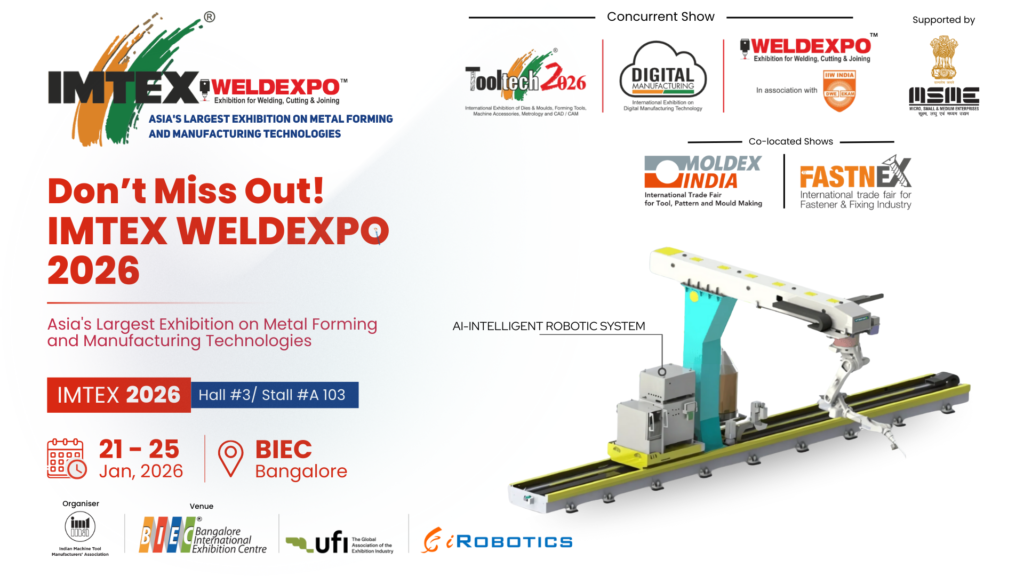
iTech Robotics and Automation Pvt. Ltd. is showcasing its AI-based Intelligent Robotic Welding System at IMTEX 2026. Visitors can experience live demonstrations and understand how this technology can be implemented in real industrial environments.
📍 IMTEX 2026 – Hall 3, Booth 103
Conclusion
The Intelligent Robotic Welding System represents a major shift from traditional automation to smart, adaptive, and AI-driven welding solutions. By removing the complexity of robot teaching and programming, it empowers manufacturers to achieve higher efficiency, flexibility, and quality in their welding operations.