

Modern manufacturing demands flexibility, precision, and speed, especially in welding operations involving complex geometries and frequent design variations. To meet these requirements, the 7-Axis Intelligent Welding Workstation has emerged as a powerful solution, combining extended robotic motion with AI-driven intelligence to deliver superior welding performance.
This next-generation workstation represents a major step forward from conventional robotic welding systems.
What Is a 7-Axis Intelligent Welding Workstation?
A 7-Axis Intelligent Welding Workstation is an advanced robotic welding setup where a 7-axis robot or cobot is integrated with AI, vision, and intelligent path-generation software. The additional axis provides greater freedom of movement, allowing the robot to reach complex weld joints, avoid obstacles, and maintain optimal torch orientation throughout the welding process.
Unlike traditional systems, this workstation does not rely on manual robot teaching or extensive programming.
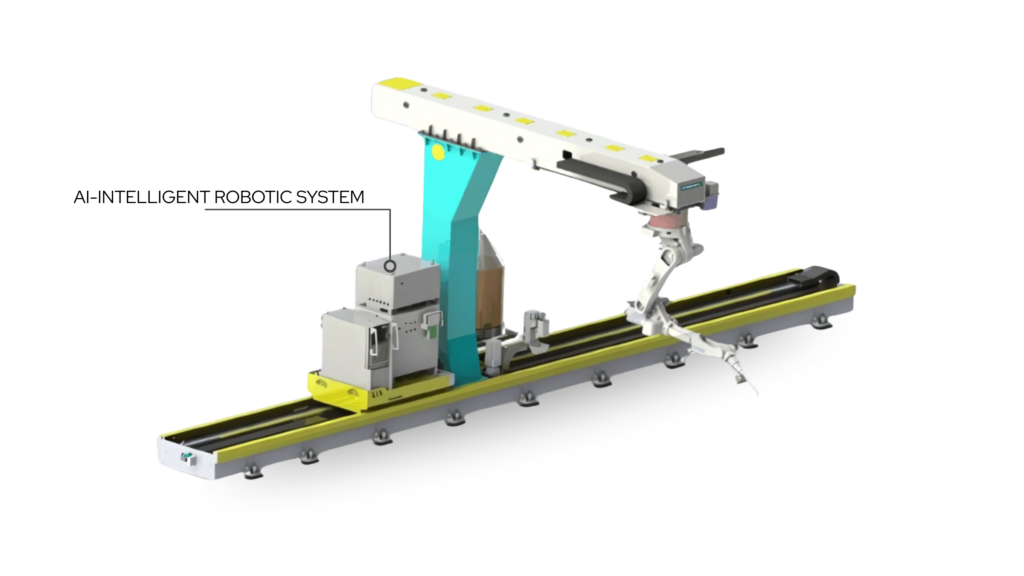
Why 7-Axis Matters in Welding Automation
Traditional 6-axis robots often face limitations when welding intricate components or working in confined spaces. The 7th axis enhances system capability by:
- Improving reachability and orientation control
- Enabling smoother and more natural welding paths
- Reducing re-positioning of parts or fixtures
- Enhancing access to complex joints and corners
- Increasing overall process flexibility
This makes the workstation ideal for high-precision and multi-geometry welding applications.
Intelligent Workflow of the Welding Workstation
The 7-Axis Intelligent Welding Workstation operates through a streamlined, AI-driven workflow:
- Component Scanning
The workpiece is scanned using vision or 3D sensing technology. - Automatic Weld Path Generation
AI algorithms analyze the geometry and automatically generate optimized welding paths. - Motion Optimization Using the 7th Axis
The additional axis ensures proper torch angle and smooth motion across complex welds. - Program Validation
The generated program can be reviewed quickly before execution. - Automated Welding Execution
The robot performs consistent, high-quality welding with minimal human intervention.
Key Features of the 7-Axis Intelligent Welding Workstation
- No Manual Robot Teaching Required
- AI-Based Welding Path Generation
- Enhanced Reach and Dexterity with 7 Axes
- High Precision and Repeatability
- Reduced Setup and Changeover Time
- Consistent Weld Quality Across Batches
- Integration with Industrial Robots or Cobots
- Compact and Modular Workstation Design
These features make the workstation suitable for both mass production and customized fabrication.
Industrial Applications
The 7-Axis Intelligent Welding Workstation is widely adopted in industries such as:
- Automotive and Auto Components
- Heavy Fabrication and Structural Welding
- Construction Equipment Manufacturing
- Shipbuilding and Railways
- Aerospace and Defense Components
- Custom Metal and Job-Shop Fabrication
Its flexibility makes it particularly valuable in high-mix, low-volume production environments.
Benefits for Manufacturers
By implementing a 7-Axis Intelligent Welding Workstation, manufacturers can achieve:
- Higher productivity and throughput
- Reduced dependency on skilled robot programmers
- Faster setup and job changeovers
- Improved weld consistency and quality
- Lower rework and scrap rates
- Enhanced operator safety
- Faster return on investment (ROI)
iTech Robotics at IMTEX 2026
iTech Robotics and Automation Pvt. Ltd. is showcasing its 7-Axis Intelligent Welding Workstation at IMTEX 2026, demonstrating how AI-driven welding automation can simplify complex industrial welding challenges.
📍 IMTEX 2026 – Hall 3, Booth 103
Visitors can experience live demonstrations and gain insights into real-world industrial applications of intelligent welding systems.
Conclusion
The 7-Axis Intelligent Welding Workstation represents the future of welding automation—combining extended robotic motion with AI-powered intelligence to deliver unmatched flexibility, precision, and efficiency. By eliminating manual teaching and enhancing motion control, it empowers manufacturers to stay competitive in an increasingly demanding industrial landscape.